















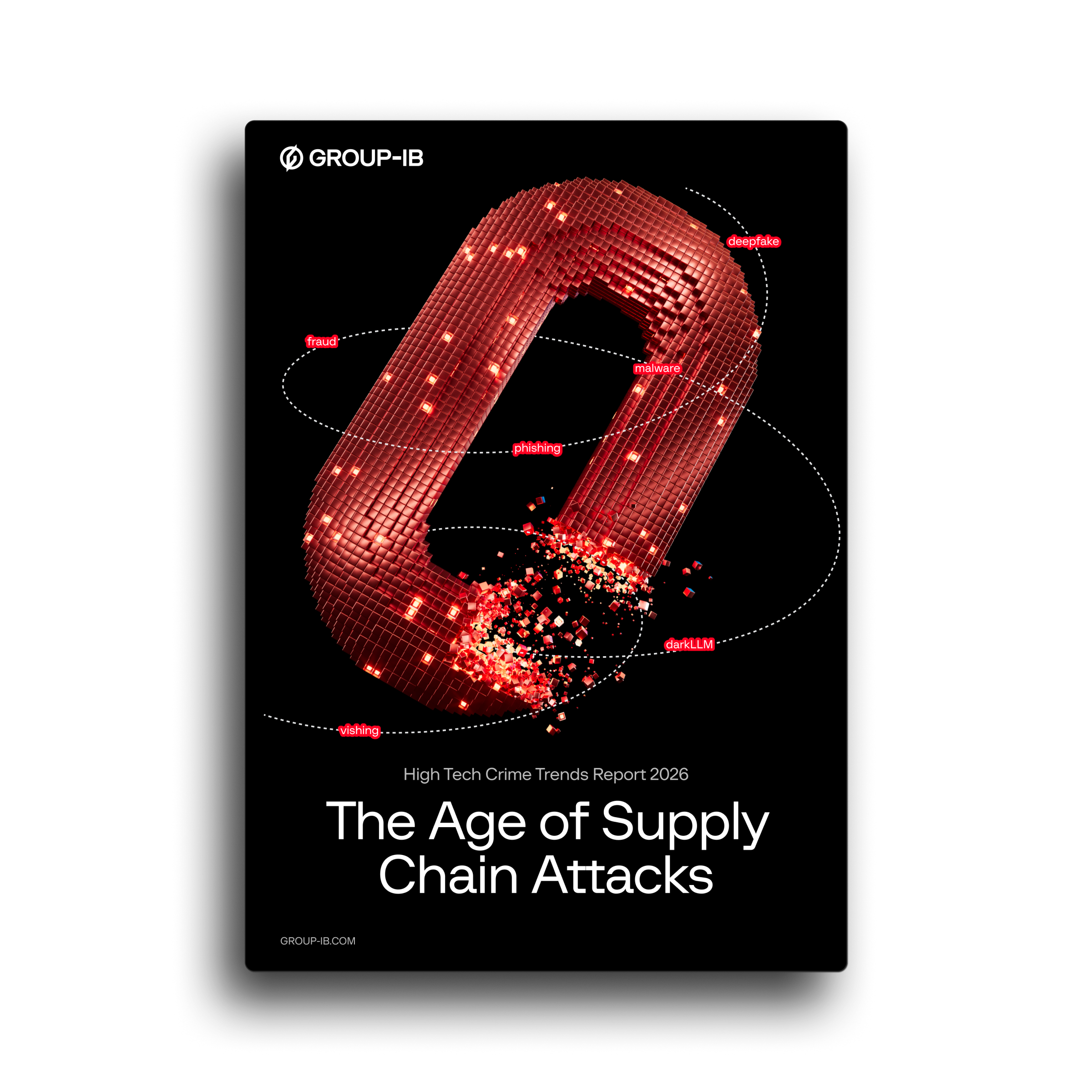
High-Tech Crime Trends Report 2026
The High-Tech Crime Trends Report 2026 reveals how this shift has industrialized cybercrime, exposed...
Get 24/7 incident response assistance from our global team
Please review the following rules before submitting your application:
1. Our main objective is to foster a community of like-minded individuals dedicated to combatting cybercrime and who have never engaged in Blackhat activities.
2. All applications must include research or a research draft. You can find content criteria in the blog. Please provide a link to your research or research draft using the form below.







Your guide to AI innovation, adoption, and acceleration in cybersecurity
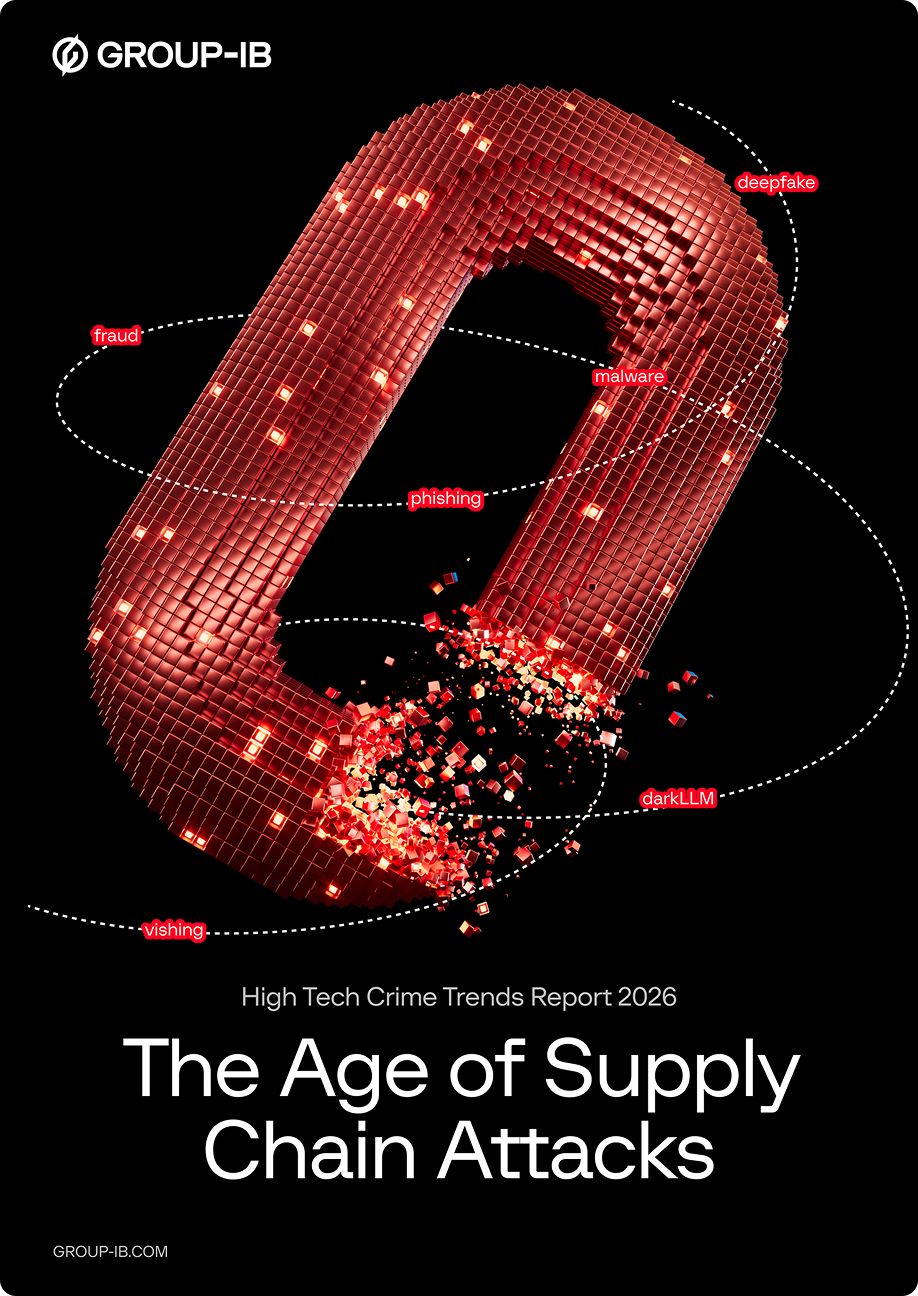
The High-Tech Crime Trends Report 2026 reveals how this shift has industrialized cybercrime, exposed the limits of perimeter-based defenses, and elevated identity and trust as the new primary attack surfaces.
Your guide to AI innovation, adoption, and acceleration in cybersecurity
Learn more
For adversaries, breaching vendors gives access to many downstream victims with less effort and greater reach. Group-IB’s cybersecurity solutions offer a unified view of your vendor ecosystem, allowing you to anticipate and prevent third-party breaches while ensuring partners meet your security standards.
Your supply chain environment is also your most vulnerable attack surface. Cybercriminals take advantage of the trust placed in partners, turning their weaknesses into direct security threats. Our intelligence-driven solutions for managing cybersecurity supply chain risks can proactively identify, assess, and mitigate risks from third parties, helping to prevent breaches and build a more resilient digital supply chain.

Gain a complete view of your extended attack surface with Attack Surface Management. The agentless solution maps all software and vendor connections to uncover and manage previously unknown security gaps.

Leverage real-time Threat Intelligence to detect compromised suppliers and emerging threats early, enabling you to neutralize risks before they impact your organization.

Go beyond simple assessments by continuously validating vendor security through services like Penetration Testing, helping you reduce overall risk and ensure your business operations remain secure.
Third-party risk extends far beyond your attack surface. It encompasses challenges like delayed threat detection, gaps in governance, outdated due diligence, and emerging AI vulnerabilities. Group-IB provides a unified defense framework designed to anticipate and neutralize risks at every layer of your partner ecosystem.
Every third-party software, cloud service, and vendor you connect with creates a potential backdoor into your network. These hidden entry points bypass traditional defenses, allowing a single compromised partner to become a direct pathway for a major breach.

of businesses formally review the risks posed by their immediate suppliers, while just 7% review their wider supply chain.
Group-IB’s Attack Surface Management continuously discovers and monitors all your external-facing digital assets, including those owned by third parties. This provides a complete map of your attack surface, allowing you to identify and remediate unknown vulnerabilities before attackers exploit them.

Business Email Protection secures your most-used communication channel against threats originating from compromised partners. It detects and blocks sophisticated phishing, malware, and BEC attacks, ensuring a trusted vendor’s email cannot be used to infiltrate your network. See how our solution could detect the NPM supply chain compromise before it spreads.

Managed XDR delivers cross-boundary correlation by integrating telemetry from cloud environments, vendors, and external assets. Group-IB experts use this unified view to proactively hunt for advanced threats, enabling rapid responses to contain malicious activity regardless of its origin.

When a third-party partner is breached, you’re often the last to know. Delays in communication and a lack of shared visibility allow attackers to move undetected between your systems, dramatically increasing the cost and complexity of containment.

The average lifecycle to identify and contain a data breach caused by a third-party vendor or supply chain compromise, the longest of any initial attack vector.
Managed XDR integrates security data from across your entire environment, including third-party cloud services. This provides a single, correlated view of threats, enabling early detection of suspicious activity that crosses organizational boundaries.
The Group-IB Network Graph visually maps your entire attack surface, revealing complex connections between your resources and external threats. By exposing the links between different assets, it allows you to see exactly which components are reachable or exploitable by an attacker, ensuring no attack path remains hidden.

When a supply chain incident occurs, every second counts. Our Incident Response team is ready to deploy immediately to investigate, contain, and eradicate threats originating from third-party connections. We minimize business disruption and provide a clear path to recovery, protecting your operations and reputation.

Relying on static questionnaires and unverified vendor claims creates a dangerous illusion of safety. True governance demands continuous validation of your partners’ security postures. Without objective evidence and expert auditing, critical vulnerabilities remain hidden, leaving your organization non-compliant and exposed.

of organizations rely on vendor self-assessment questionnaires for due diligence, a static and biased approach that provides no continuous, objective security evidence.
Governance begins with a solid foundation. SOC Consulting services help you design and implement a robust supply chain security framework. We identify gaps in your current policies, ensure compliance with industry regulations (like GDPR, ISO), and establish clear protocols for vendor risk management.

Standard scans often miss advanced threats that are already dormant inside a partner’s network. Compromise Assessment performs a deep forensic sweep of the infrastructure to detect active breaches, backdoors, and implants that evade conventional tools. This ensures you don’t inherit a compromised environment during vendor onboarding or M&A integration.

A compliant vendor is not necessarily a secure one. Red Teaming simulates full-scale, intelligence-driven attacks on your supply chain to test how well your team and your partners detect and respond to a breach. This stress-tests your people, processes, and technology in a real-world scenario.

As you adopt new technologies like AI, third-party plug-ins, cloud-native infrastructure, and marketplace extensions, your attack surface expands in ways traditional security tools can’t measure. These fast-moving, often unaudited dependencies create new, complex pathways for data theft and fraud.

of breached organizations said they don’t have governance policies in place to manage AI or detect shadow AI.
Your existing security can’t see AI-specific risks like prompt injection or data poisoning. Our AI Red Teaming service simulates real-world attacks on your AI models and applications, helping you identify and close these new vulnerabilities before they are exploited.
Cloud environments are a primary vector for supply chain attacks. Attackers can detect exposed S3 buckets in as little as 11 minutes. Our Vulnerability Assessment service identifies forgotten infrastructure, shadow IT, and misconfigured permissions that automated tools often miss, ensuring your cloud posture is resilient against third-party compromise.

New third-party extensions can be exploited to commit fraud against your users. Our Fraud Protection platform uses advanced behavioral analysis and device fingerprinting to detect and block sophisticated fraud in real time across your web and mobile applications.

You can’t defend against threats you don’t know exist. Our Threat Intelligence platform provides strategic insights into the latest attacker tactics and future threats, enabling you to proactively strengthen your defenses as you adopt new technologies.


Supply chain attacks often start with a single compromised account through targeted phishing emails. The NPM software supply chain compromise showed how one successful lure can trigger downstream exposure and spread through trusted packages and updates. With every vendor and software dependency, the number of entry points grows, outpacing what traditional security tools can manage.
Group-IB’s cybersecurity solutions are built to address this challenge. We combine continuous attack surface discovery, adversary intelligence, and 24/7 detection and response to map your ecosystem, identify cross-boundary threats early, and neutralize third-party risks before they become critical incidents.
Schedule a consultation to identify your biggest supply chain vulnerabilities and discover how our intelligence-driven solutions can protect your organization.

A supply chain attack is an indirect cyberattack where threat actors compromise an organization by exploiting vulnerabilities in one of its less secure third-party partners, such as a software vendor or supplier. This approach uses the trusted relationship between the two parties to bypass the main target’s defenses.
Supply chain cybersecurity solutions are crucial because an organization’s security is now defined by its entire partner ecosystem. These solutions provide essential visibility to manage risks from third-party vendors, as a single compromised partner can bypass traditional defenses and lead to a major breach.
Cybersecurity supply chain risk management is a continuous process that involves several key stages. It starts with gaining complete visibility by mapping all third-party vendors and software dependencies to identify potential blind spots. This is followed by continuous monitoring and threat intelligence to detect emerging risks. Finally, it involves proactive validation through assessments and testing to ensure partners’ security controls are effective.
Group-IB’s supply chain cybersecurity solutions provide a comprehensive, intelligence-driven framework to secure your entire digital supply chain. We help you gain visibility into your external attack surface, proactively test vendor defenses with services like Penetration Testing and Red Teaming, and provide continuous threat detection and response with our Managed XDR. Our consulting and education services also help strengthen your internal processes and team readiness against third-party threats.
The most common types of supply chain attacks include Software Supply Chain Compromise, where attackers inject malicious code into a legitimate software update, which is then distributed to all the vendor’s customers, and Third-Party Vulnerability Exploitation, which involves using a known vulnerability in a third-party application to gain access to a target’s network.
Other common attacks include Third-Party Credential Compromise, where attackers use stolen credentials from a less secure partner to access a company’s systems, and Business Email Compromise (BEC), which involves impersonating a trusted vendor’s email to authorize fraudulent payments or steal data.