















Beyond Compliance: Cyber and Operational Resilience Framework (CORF) Readiness For Kuwaiti Banks
The Central Bank of Kuwait's Cyber and Operational Resilience Framework (CORF v1.0) is a complete...
Get 24/7 incident response assistance from our global team







Your guide to AI innovation, adoption, and acceleration in cybersecurity

Modern fraud isn't an event. It's an industrialised campaign that begins weeks before the payment. The transaction is where fraud ends, not where it happens. This paper shows how to disrupt the campaign weeks before the payment, not document it after.
Your guide to AI innovation, adoption, and acceleration in cybersecurity
Learn more

Embedded in this paper, a fraud exposure calculator helps you quantify the gap between what your books record and what your fraud controls are already signalling, before your next budget conversation.
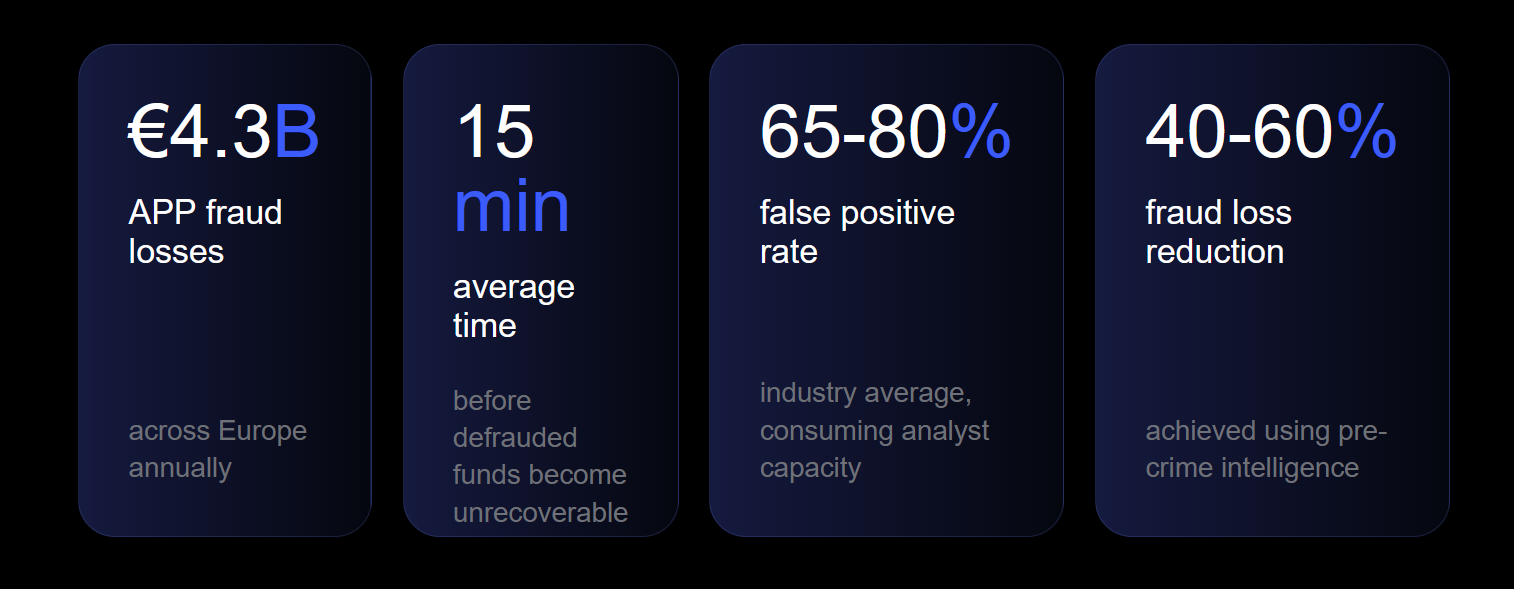
Most European banks are fighting fraud with infrastructure that was built for a different problem. They’re detecting fraud that has already happened by reviewing transactions, filing suspicious activity reports, and reimbursing customers after funds have cleared.
That model has three compounding problems.
First, the 15-minute crime window: funds are typically unrecoverable before the detection system triggers.
Second, the PSR liability shift: reimbursement liability moves onto the institution and the standard is prevention, not detection.
Third, the intelligence paradox: every institution is seeing fragments of the same criminal networks, but they can’t share those signals without GDPR exposure, so the criminals operate across institutions that are fighting them independently.
Group-IB’s approach is different. We operate upstream, in the criminal ecosystem, monitoring adversary infrastructure, fraud kit deployment, and mule recruitment before attacks are launched. That intelligence reaches institutions before the transaction, not after.
 Head of Fraud RiskCISOFraud Operations AnalystCFO / Risk OfficerThe Intelligence-Sharing ParadoxThe PSR Liability MapThe Fraud MatrixThe Fragmentation Blind Spot
Ready to talk?
We see the full picture of the evolving cyber threat landscape thanks to unique tools for monitoring the infrastructure used by cybercriminals and data from battlefields:


