





















Introduction
Brand attacks no longer begin when a phishing page goes live. They begin when a threat actor registers the domain, configures the hosting, and clones the kit, which may be hours or even days before a victim clicks anything.
The signals exist. The problem is they’ve never reached the SOC. The Group-IB research team has documented this infrastructure preparation phase across hundreds of operations. The window to intervene exists. The problem of the signal never reaching the SOC — that is what this integration addresses.
What is Group-IB Digital Risk Protection (DRP)?
Group-IB Digital Risk Protection (DRP) detects and disrupts the illegitimate use of a company’s brand across the entire digital surface: websites, forums, advertisements, mobile apps, marketplaces, and social channels.
What separates it from standard brand monitoring is that Group-IB Digital Risk Protection (DRP) intervenes at the infrastructure preparation stage, before threats go live. Using adversarial intelligence, it identifies malicious hosts hours before phishing content appears, operating on infrastructure signals: DNS patterns, WHOIS data, IP behavior, and phishing kit fingerprints. By the time a threat activates, Digital Risk Protection has already flagged it, clustered it with related violations, and attributed it to known threat actor groups.
When a violation is confirmed, automated takedown procedures block victim traffic within minutes through combining automation with a global partner network to accelerate takedowns.
Group-IB Digital Risk Protection covers the full brand attack surface: anti-scam and anti-phishing, anti-counterfeiting, identity intelligence and compromise monitoring, and VIP and executive protection, backed by 24/7 monitoring and a global network of enforcement partners.
Why integrate Digital Risk Protection with Google SecOps SOAR?
TLDR: The integration centralizes Digital Risk Protection alerts in Google SecOps so analysts don’t have to jump between tools, correlates external digital-risk signals with internal telemetry for better detection, and enables SOAR automation to respond faster and more consistently.
Here, we expand on the use cases:
Unified console and analyst fatigue reduction
Modern security operations centres (SOCs) are often overwhelmed by the lack of context related to alerts and the large number of tools they must use, many of which do not integrate with each other. More than half of organizations pursue vendor consolidation because switching between consoles reduces analyst productivity. Tool overload is so acute that analysts spend more time managing integrations than defending the organisation.

Integrating Group-IB Digital Risk Protection into Google SecOps addresses this challenge by pulling external digital‑risk alerts into a unified SIEM/SOAR environment. A survey on single‑pane monitoring found that consolidating information in one view helps teams reduce incident response time, route issues more efficiently and shift from reactive to proactive monitoring. With this integration analyst can view all contextual data from violations without leaving Google SecOps.
This integration also makes it easier to correlate digital‑risk indicators with internal events (for example, matching a newly detected phishing domain against corporate proxy logs). Consolidation reduces context‑switching and simplifies investigations, which helps alleviate alert fatigue and accelerates time to resolution.
As the violations are represented as alerts in cases in SOAR, dashboards can be created to provide an overview of Digital Risk Protection information. Examples of that information could be:
- Violation overview: Number of Digital Risk Protection violations per time (day/week), grouped by module (anti‑scam, leak detection, anti‑counterfeiting, VIP protection and anti‑piracy) or by severity (high/medium/low), enabling trend analysis.
- Top sources and targets: bar charts listing the most abused brand elements and the digital channels where violations occur most frequently.
- Takedown status: a summary table of open Digital Risk Protection cases with current status (detected, under review, takedown initiated, removed).
Sample playbook for Digital Risk Protection violation handling
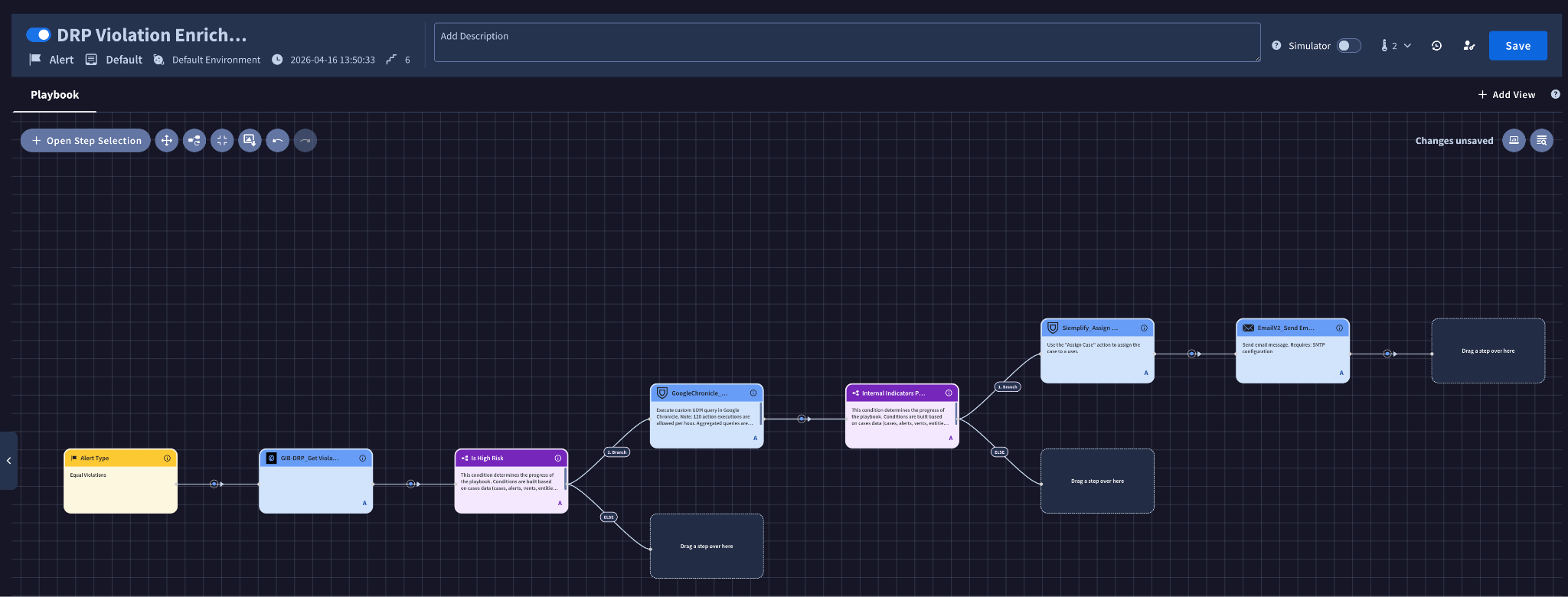
The following is a high-level example of a seven-step playbook implementable in Google SecOps SOAR, automating the response to a Digital Risk Protection violation while retaining human oversight where necessary:
| Step | Action | What happens |
|---|---|---|
| 1 | Trigger | Google SecOps ingests a new DRP violation alert, for example, a phishing domain impersonating the brand or a counterfeit product listing. |
| 2 | Context enrichment | Playbook queries the DRP API for detailed violation information — stored in case notes. |
| 3 | Internal correlation | SecOps queries proxy logs, DNS logs, or endpoint telemetry for the offending domain/IP — returns internal hit count and any affected user accounts. |
| 4 | Conditional branching | Internal hits → high-priority branch: analyst assigned, notifications sent, blocking initiated. No hits → low-priority branch: minimal notifications, no further action. |
| 5 | Analyst assignment | Case automatically assigned with enriched data and correlation results. |
| 6 | Stakeholder notification | Alerts sent via email, Google Chat, or Slack to IR teams highlighting risk and suggesting immediate investigation. |
| 7 | Blocking actions | Optionally instructs security infrastructure to block network access to the malicious domain/IP and isolate any compromised endpoint. |
Outcome
Implementing such a playbook allows organizations to respond rapidly and consistently to digital-risk incidents. It reduces manual triage, improves cross-team collaboration, and ensures high-risk events receive immediate attention while lower-risk issues are continuously monitored.
Bridging external digital risk with internal security monitoring
Group-IB Digital Risk Protection monitors external digital channels for brand abuse. Integrating these signals with Google SecOps allows organizations to correlate external indicators with internal telemetry, enabling earlier detection of attacks and more informed threat hunting.
For example: If Digital Risk Protection detects a newly registered domain impersonating the brand, a SecOps playbook can automatically create detection rules correlating that domain with network traffic logs, or include its indicators in a SecOps SIEM Data Table used by a pre-built detection rule.
External brand signal becomes internal threat intelligence. The phishing domain your customers are clicking becomes the indicator your SOC is already hunting against.
This approach flags attempted connections, downloads, or login attempts related to brand-abuse infrastructure, earlier and with less manual effort.
How does the integration work?
Group-IB Digital Risk Protection (DRP) integration automatically ingest brand threat violations (e.g., phishing pages, counterfeit stores, typosquatting domains) as structured cases in Google SecOps SOAR. Google SecOps can communicate with Digital Risk Protection via actions to approve or reject violations. Those actions can be executed automatically via playbook or manually by the analyst.
For a full walkthrough of the object lifecycle, refer to the Digital Risk Protection integration documentation.
In a simple diagram, the integration looks like this:

Connectors:
- Digital Risk Protection Violations Connector. Ingests all new violations. Supports optional filtering by brand, section, subtype, and approved state.
- Digital Risk Protection Violations Review Connector. Ingests only violations currently under analyst review. Use when a human decision is required before takedown.
- Digital Risk Protection Typosquatting Connector. Ingests violations flagged as typosquatting detections, keeping them in a separate case queue.
Actions:
- Get Violation Details. Fetches full metadata from Digital Risk Protection and renders it as an insight card on the DestinationURL entity.
- URL-Approve. Submits a takedown request to Group-IB for the selected violation URL.
- URL-Reject. Marks a violation as a false positive in the Digital Risk Protection portal.
- Ping. Tests API connectivity. Use during setup to validate credentials and network access.
Introducing ciaops: Extending automation beyond the SOC
The integration of DRP with Google SecOps was built on ciaops — Group-IB’s lightweight Python SDK that powers the connectors and actions described above.
For teams wanting programmatic control beyond the SOAR connector, and deeper customization, ciaops also works as a standalone layer, simplifying interaction with Group-IB’s Digital Risk Protection (DRP), Threat Intelligence (TI), and Attack Surface Management (ASM) APIs.
Instead of crafting raw HTTP requests and parsing JSON, users instantiate a poller class with their credentials. Each poller manages sessions, handles rate limits, and generates portions of data for efficient iteration. ciaops includes typed constants for collection names to prevent typos and improve code completion, plus helpers for custom parsing, making it straightforward to map nested fields into simple dictionaries or extract IoCs
For Digital Risk Protection specifically, the DRPPoller exposes methods to fetch violation feeds incrementally using create_update_generator() and to search specific violations by ID. Filters let you target violation subtypes, sections (web, mobile, marketplace, social), or brands. The poller also allows status changes (approve/reject) when a human analyst decides a takedown is warranted.
Ciaops works as a standalone automation layer, or as a connector between any custom solution and Group-IB’s APIs. The same automation logic described in your SOAR playbooks can be implemented programmatically, independent of the Google SecOps environment.

Brand threats that start outside your perimeter, now stopped in your SOC
Brand attacks begin in external infrastructure. With this integration, they become actionable intelligence inside your SOC.
Group-IB’s Digital Risk Protection integration with Google SecOps centralizes brand-abuse alerts, correlates external digital-risk signals with internal telemetry, and enables automated response through SOAR playbooks. This reduces tool switching, improves prioritization, and accelerates response to phishing, impersonation, and counterfeit threats.
The ciaops SDK extends this further enabling flexible programmatic automation across Digital Risk Protection (DRP), Threat Intelligence (TI), and Attack Surface Management (ASM) APIs for any custom integration scenario.
Group-IB’s Digital Risk Protection is built on the same adversarial intelligence infrastructure that powers Group-IB Threat Intelligence and incident response operations across 1,600+ investigations. Brand threats that begin in underground infrastructure now surface in your SOC’s playbook, before the first victim clicks.
Exclusively for Group-IB DRP clients: connect your environment with Google SecOps
Explore the integration or read the full DRP object lifecycle documentation.


