






















Group-IB, a leading creator of cybersecurity technologies to investigate, prevent, and fight digital crime, launched today its High-Tech Crime Trends Report 2026, revealing that supply chain attacks have become the dominant force reshaping the global cyber threat landscape.
Mapping the web of deceit in supply chain attacks
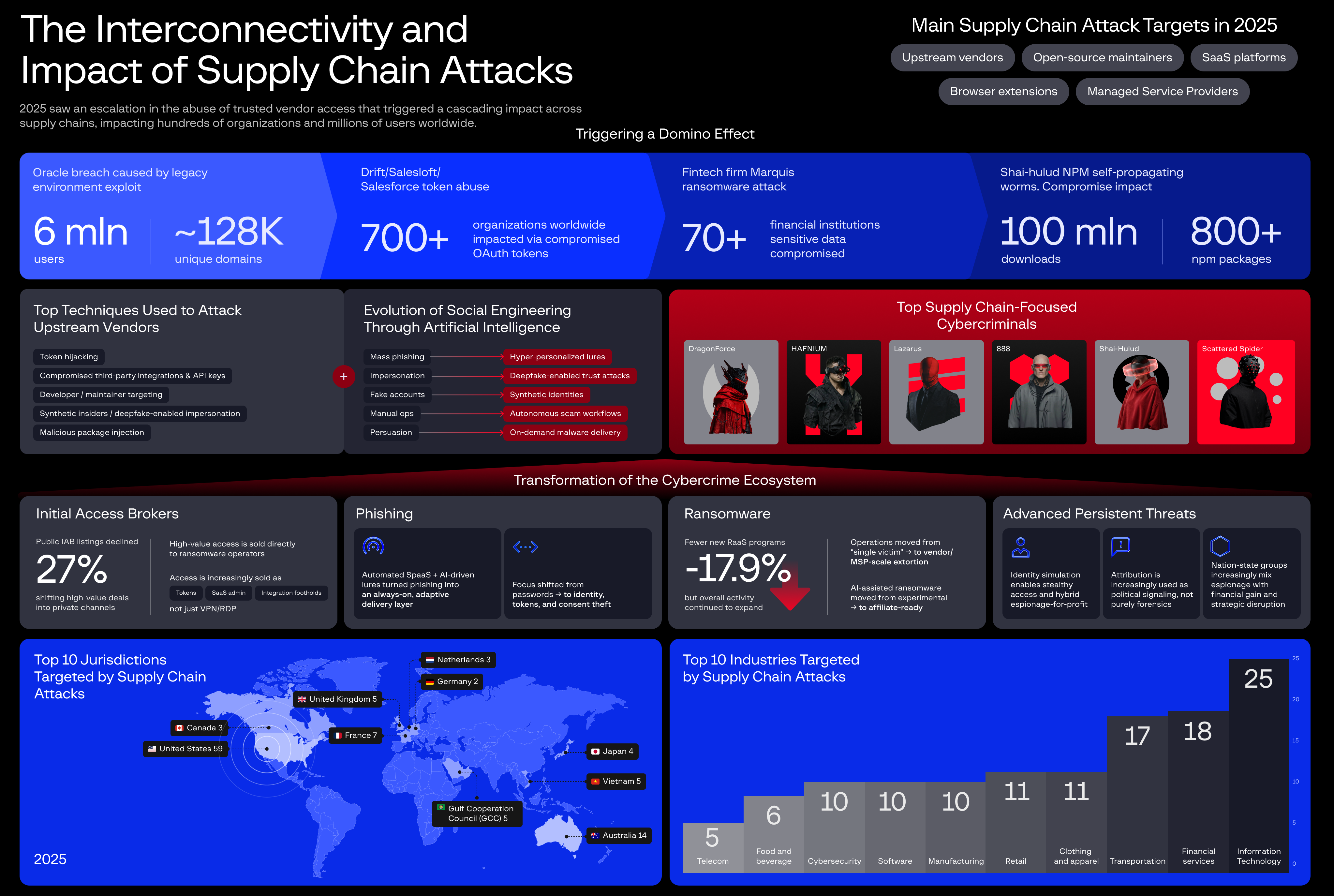
This year’s High-Tech Crime Trends report reveals that cybercrime has shifted decisively away from isolated intrusions toward ecosystem-wide compromise, where attackers exploit trusted vendors, open-source software, SaaS platforms, browser extensions, and managed service providers to gain inherited access to hundreds of downstream organizations.
Drawing on worldwide telemetry alongside on-the-ground investigations, the report combines Group-IB’s adversary-centric and global analysis with real-world regional case studies to illustrate how supply chain compromises unfold across industries and geographies. These cases span open-source package poisoning, malicious browser extensions, OAuth token abuse, cascading SaaS breaches, and ransomware operations fueled by upstream access brokers — demonstrating how a single localized intrusion can rapidly escalate into large-scale, cross-border impact.
Powered by Group-IB’s proprietary predictive intelligence, the report finds that modern supply chain attacks no longer operate as standalone incidents. Instead, phishing, identity compromise, malicious extensions, data breaches, ransomware, and extortion increasingly function as interconnected stages of a single attack chain — each reinforcing the next.
Key findings in the High-Tech Crime Trends Report 2026
- Open-source ecosystems under siege: Package repositories such as npm and PyPI have become prime targets, stolen maintainer credentials, and automated malware worms to compromise widely used libraries — turning development pipelines into large-scale distribution channels for malicious code.
- The rise of malicious browser extensions: Threat actors increasingly weaponize trusted browser add-ons, hijacking official marketplaces and developer accounts to harvest credentials, hijack sessions, and steal financial data directly from users’ browsers.
- Phishing-driven identity compromise: AI-powered phishing campaigns now target high-trust integrations and OAuth workflows, allowing attackers to bypass MFA and gain persistent, legitimate access to SaaS platforms, CI/CD pipelines, and cloud environments.
- Data breaches as force multipliers: Rather than pursuing single-victim leaks, attackers are moving upstream — compromising service providers and integration layers to trigger multi-tenant exposure and cascading downstream impact.
- An industrialized ransomware supply chain: Initial Access Brokers, data brokers, and ransomware operators now operate as tightly coordinated ecosystems, focusing on upstream access points to maximize operational and financial damage.
“Cybercrime is no longer defined by single breaches. It is defined by cascading failures of trust. Attackers are industrializing supply chain compromise because it delivers scale, speed, and stealth. A single upstream breach can now ripple across entire industries. Defenders must stop thinking in terms of isolated systems and start securing trust itself, across every relationship, identity, and dependency.”

Chief Executive Officer of Group-IB
Through detailed case studies and threat actor profiling, the High-Tech Crime Trends Report 2026 highlights how 2025 marked a pivotal escalation in supply chain threats — Discover how cybercrime now targets entire ecosystems. Group-IB’s High-Tech Crime Trends report reveals supply chain attacks, SaaS breaches, ransomware, and interconnected threat chains.from the weaponization of open-source ecosystems and the rise of malicious browser extensions to AI-driven phishing, OAuth abuse, and the emergence of an industrialized ransomware supply chain. The report documents sustained activity by supply-chain-focused actors such as Lazarus, Scattered Spider, HAFNIUM, DragonForce, 888, and campaigns linked to Shai-Hulud, underscoring how both criminal groups and state-aligned operators are exploiting the same trusted platforms and integration layers to achieve asymmetric impact at scale.
The High-Tech Crime Trends Report 2026 is powered by unique intelligence from Group-IB’s Digital Crime Resistance Centers (DCRCs) in 11 countries around the world, and adversary-centric telemetry, combined with real-world cybercriminal investigations, and round-the-clock global monitoring of underground ecosystems. It provides actionable insight for enterprises, governments, and law enforcement seeking to anticipate emerging risks and disrupt attack chains before damage occurs.
Download the High-Tech Crime Trends Report 2026 now to gain further insights on supply chain attacks.